WeChat: Your Ultimate Travel Planning Tool

WeChat, widely known as China’s all-in-one super app, has revolutionized the way people communicate, socialize, and conduct financial transactions, but now we’ve got yet another sector coming into the ring.

While it was not initially designed as a travel planning tool, recent developments within the platform indicate a growing appetite to venture into the market share traditionally dominated by Online Travel Agencies (OTAs). This shift is particularly notable, given the whirlwind of changes the travel industry has gone through in recent years. After three long years of restricted international travel due to the global pandemic, the world is witnessing a resurgence in wanderlust. As a result, there has been a noticeable surge in travel-related content on WeChat. Users are sharing their travel experiences, tips, and recommendations, transforming the platform into a hub for travel enthusiasts.

Moreover, recent statistics reveal that a substantial portion of the Chinese population is eager to resume their international travel plans. According to a survey published by Dragon Trail Research, an astounding 60% of Chinese individuals have expressed their intentions to travel abroad this year. This renewed enthusiasm for international tourism presents a unique opportunity for WeChat to leverage its existing user base and expand its influence in the industry.

In this article, we will delve into the emerging travel-related features on WeChat and analyze how they position the platform to potentially challenge the dominance of traditional OTAs. We will also explore the implications of WeChat’s growing travel focus, both for its user base and the wider travel industry, as we navigate the new landscape of post-pandemic tourism.

WeChat as a one-stop platform to organize a trip

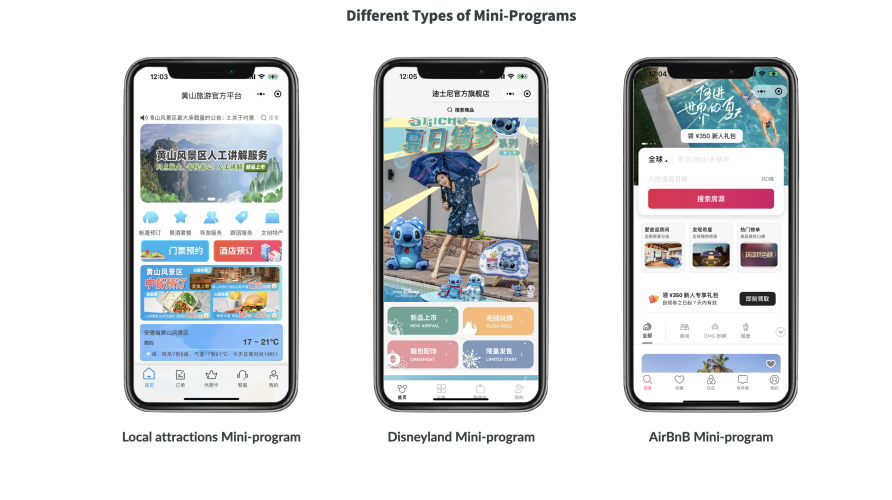
Mini-programs are the core of any planning tools on WeChat. Chinese Travel Consumption Trends White Paper 2023, released by Tencent Marketing Insight and Tongcheng Research Institute highlight the value and popularity of WeChat mini-programs for Chinese travelers. According to the findings, 61% of respondents said they use WeChat mini-programs to purchase travel products and services while on trips. Additionally, 34% stated that they utilize mini-programs for accommodation, transportation, attraction tickets, activities, and/or F&B, while 24% each use the mini-programs of travel platforms and OTAs.

Brands can leverage mini-programs in many ways. For example by embedding a link within the articles, pin to their official account WeChat menus, and much more.

WeChat mini-programs are simply convenient and don’t require downloading additional apps. On top of that, since they are vetted by Tencent they are also perceived as more reliable.
Mini Programs Travel WeChat

👀 Discover more about WeChat Mini-Programs

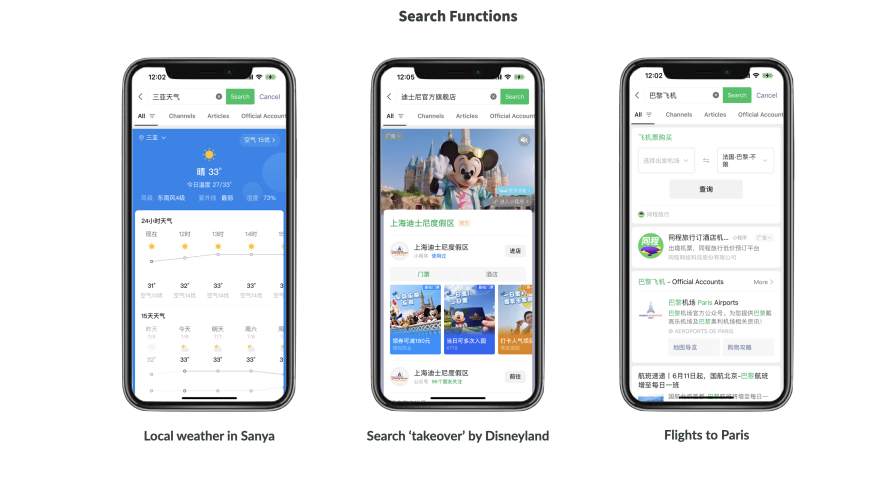
WeChat Search is another amazing tool in the WeChat’s arsenal. Users can search for virtually any kind of information from quick results for the weather forecast at their destination to suggested flight routes or accommodations.  In the Search results, users can also browse through official WeChat accounts, video content, mini-programs, and more. Filtering option help them to find relevant information quickly.

One particularly eye-catching feature that can be leveraged by brands is ‘search takeover’ where brands can customize their result card and include buttons driving to different functions like booking.
WeChat Search Travel

🔍 A Quick Guide To WeChat Search

Travel Content on Official Accounts

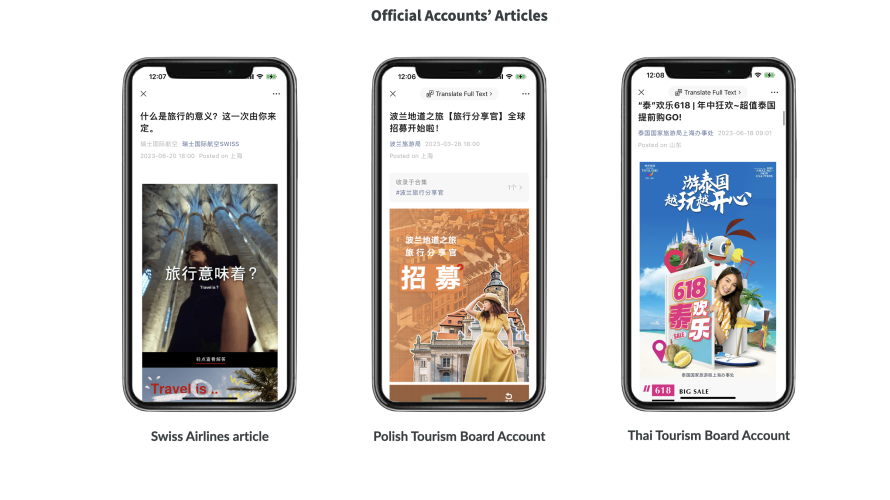
WeChat Official Accounts, let’s not forget content published on official accounts. They remain the most important source of information and updates for Chinese travelers. That’s why it’s so important to keep them up to date. Menu, which is a close equivalent of a website, should be updated and make it easy to navigate for FAQ. Chinese customers will appreciate responsive customer service and auto-replies.

Articles can serve as a great source of inspiration. Taking into account that 17% of Chinese travelers admit that they use WeChat to plan outbound trips, there is a big chance that they might come across the content that spark their wanderlust within the platform. This rising interest in globetrotting content is already visible. According to Q1 2023 WeChat Rankings Report, average views per post on WeChat rose by 41% for airlines. Similarly, 30% for cruise trips, 42% for attractions, and 15% for hotels.
WeChat Articles Travel Tourists

✈️Reaching Chinese Tourists: Online Travel Agencies and Social Media Platforms [2023]

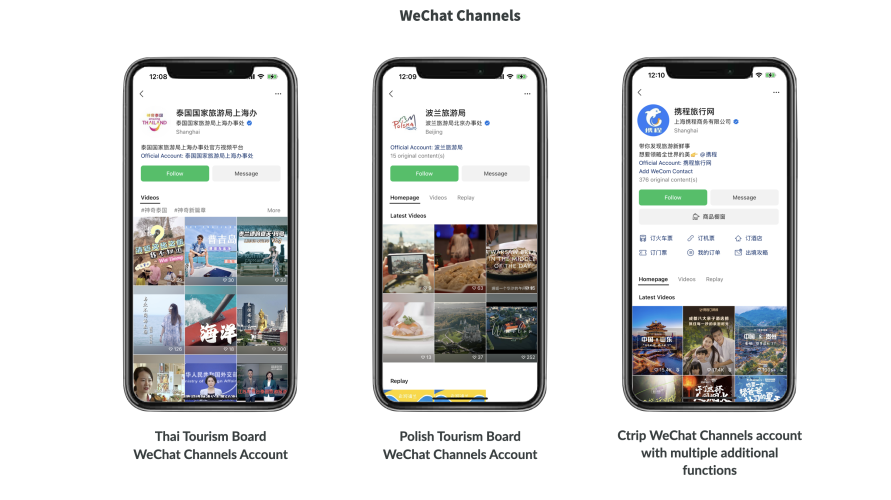
Last but not least, WeChat Channels can be used to find new inspirations. Viewers can discover hot spots in cities and unknown places worth a visit. With similar to Douyin’s algorithm-based feed, Channels are the must-have hub for visual video content on WeChat. Global and local attractions are already using built-in live-steaming features. Users can also browse content based on their location in order to find new hidden gems. They can also create their own content and raise awareness and promote places through UGC (user-generated content).
WeChat Channels Travel Tourists

🎥 WeChat Channels – How to Post for Success?

Conclusions

WeChat recently published a post on how the app can be used for planning a trip from the scratch. All without the need to download any other apps or leaving the platform. Click here to check it: 微信搜一搜是懂五一的. If you have any questions about leveraging WeChat for tourism, please contact our team. We use our knowledge and expertise to help businesses build meaningful partnerships and develop their network among Chinese customers. For additional information, please contact at contact@thewechatagency.com.

Unlocking Opportunities: Current Updates from the Chinese Market

China’s short video war heats up as Tencent offers cash to influencers from rivals Douyin and Kuaishou


Tencent’s Weishi, a short video app, is enticing influencers from competing platforms, such as Douyin, TikTok’s Chinese counterpart, by offering cash rewards and other perks. This strategic move aims to capture the attention of viewers in the highly competitive market.

The program primarily targets content creators specializing in movie reviews, healthcare, parenting, and other relevant fields. Additionally, Weishi actively seeks individuals with a relatable and “down-to-earth” lifestyle to participate.

It is important to note that this recruitment initiative aligns with standard industry practices and is not a recent development for Weishi. After witnessing the immense success of ByteDance’s Douyin, which popularized short videos, Tencent revived Weishi in 2018. Subsequently, in 2021, Tencent merged Weishi with its long-form video platform, Tencent Video, creating a unified operation within its platform and content group.

https://www.scmp.com/tech/tech-trends/article/3220197/chinas-short-video-war-heats-tencent-offers-cash-influencers-rivals-douyin-and-kuaishou

Douyin (Chinese TikTok) saw an 80% increase in e-commerce total sales last year


In the year 2022, the total expenditure of consumers on purchases made through the short video platform amounted to RMB 1.41 trillion ($201.4 billion).

Douyin, owned by ByteDance, is actively promoting and encouraging its video viewers to engage in shopping activities through livestreaming and the app’s marketplace channel. This strategic move by the platform aims to diversify its revenue sources and explore new avenues for generating income.

During Douyin’s annual ecosystem conference held in Guangzhou, Wei Wenwen, the president of Douyin’s e-commerce division, unveiled plans to allocate RMB 10 billion to provide support to merchants and facilitate their businesses on the platform.

https://36kr.com/p/2261274230894216

Tencent Games see 25% growth in overseas gaming sector in Q1


In its latest financial report, Tencent, the Chinese tech giant, announced robust growth in gaming revenues during the first quarter. The company’s overseas gaming revenue experienced a significant increase of 25% compared to the previous year, reaching RMB 13.2 billion ($1.88 billion).

Similarly, gaming revenue within the Chinese market witnessed a year-on-year growth of 6%, amounting to RMB 35.1 billion ($5 billion). Tencent’s performance exceeded analysts’ expectations, with the company’s total revenue for the first quarter reaching RMB 150 billion ($21.8 billion), marking an 11% increase compared to the previous year. On a non-IFRS basis, the net profit for the period reached RMB 33.4 billion ($4.9 billion), representing a 27% year-on-year growth.

https://technode.com/2023/05/18/tencent-games-see-25-growth-in-overseas-gaming-sector-in-q1/

More and more brands are using young men as anchors


What is the rationale behind brands using “boys” for live streaming? Will the “boys trend” emerge as a new trend amidst the increasing competition for audience attention and rising solicitation costs?

Utilizing “male appearance level” to tap into organic traffic has become an unspoken consensus among numerous brands. According to data from the Forward-Looking Industry Research Institute in 2021, women constitute 53.8% of Chinese live streaming e-commerce orders, positioning them as the primary consumer group. Platforms like Taobao and Douyin see women accounting for over 60% of users placing orders. Additionally, in terms of age demographics, young and middle-aged individuals form the main consumer base for live streaming e-commerce products. Notably, nearly 30% of viewers belong to the post-1995 and post-2000 generations. Young women exhibit distinct advantages in the realm of live streaming.

Particularly in areas such as beauty products, skincare items, and household goods, women serve as the primary consumer group. Although the correlation between male hosts and products may not be significant, they can pique consumers’ curiosity, foster a sense of participation, and enhance brand attention.

https://mp.weixin.qq.com/s/ytJ005A5HISf9uK-Ka2h-w

62% Of Chinese Luxury Shoppers Are Buying At Home Vs. In European Capitals


Even with the reopening of international borders, Chinese luxury consumers continue to opt for domestic shopping.

In April 2023, 62% of luxury expenditures by Chinese consumers were made within China. As a result, domestic high-end retailers are witnessing robust sales growth.

Chinese consumers have a preference for personalized experiences and interactions with local sales associates. In response to this trend, luxury brands are expanding their presence in China by opening more stores and making global price adjustments.

These brands are also investing in experiential flagship stores and VIP-only boutiques to cater to the expectations of Chinese luxury consumers, who value personalized experiences and seek added value from the brands they choose.

Thus, despite the reopening of international travel, a significant portion of Chinese luxury consumption remains concentrated within China.

https://jingdaily.com/62-chinese-luxury-shoppers-buying-at-home-vs-in-european-capitals/


Strong Domestic Travel Rebound In China Foreshadows Return Of Global Chinese Tourism


There has been a notable increase in the demand for overseas travel and a rise in international spending. However, Chinese consumers are showing less interest in traditionally popular destinations such as Europe compared to pre-pandemic times.

Many Chinese consumers still have concerns regarding deterrents and factors that include the absence of adequate COVID-19 safety measures, strict testing requirements, and barriers related to visa acquisition.

Chinese travelers are now in search of unique and novel experiences and are willing to invest in entertainment, dining, shopping, and distinctive accommodations, including boutique hotels and one-of-a-kind Airbnb homestays.

Specifically, individuals aged between 21 and 45, as well as those with higher incomes, have demonstrated a strong desire to resume overseas travel.

https://jingdaily.com/china-international-outbound-travel-mckinsey/


5 strategies domestic brands use to outshine foreign ones


Chinese domestic brands are capitalizing on their local advantage to challenge the positive reputation enjoyed by foreign brands.

The emergence of the “Guochao” concept highlights consumers’ inclination towards brands that embrace Chinese culture, traditional flavors, scents, and symbols.

To remain competitive in the Chinese market, brands need to prioritize digital transformation, innovation, and establish a strong presence on various social media platforms.

Social media platforms play a pivotal role in brand growth, and features like live commerce contribute significantly to increased sales.

Brands are adopting an omni-channel approach by transforming physical stores into immersive experiences while simultaneously expanding sales through e-commerce channels.

In addition to Key Opinion Leader (KOL) strategies, brands are incorporating Key Opinion Consumers (KOCs) to attract and retain more loyal customers, effectively bridging the gap between brands and their target audience.

Recent Updates and Industry Highlights

Face-swapping fraud sparks AI-powered crime fears in China


China is dealing with a major deepfake scam, which has raised concerns about an increase in fraudulent activities utilising AI tools such as face swapping and voice mimicry.

The case revolves around a prominent tech firm in Fuzhou, whose legal representative was reportedly swindled out of RMB 4.3 million ($610,000) after engaging in a video call with an imposter posing as a “friend” through the exploitation of AI face-swapping technology.

This incident has triggered extensive discussions on the ability of AI to deceive well-educated individuals in a matter of minutes. While China is still in the early stages of formulating regulations for AI, the nation’s internet regulator recently released a draft regulation addressing the use of generative AI and invited public input on the proposed measures.

The initial enthusiasm surrounding advancements like ChatGPT in China has been overshadowed by apprehensions regarding the potential misuse of AI to facilitate criminal endeavors.

https://technode.com/2023/05/24/face-swapping-fraud-sparks-ai-powered-crime-fears-in-china/

Tencent’s super app WeChat announced the official introduction of palm payment


WeChat’s palm pay feature demonstrates its adaptability to varying lighting conditions and the unique physiological characteristics of individuals’ palm lines.

This innovative payment method has been initially introduced on the subway line that connects to Beijing’s Daxing Airport. By utilizing this newly launched feature, users can now complete their entire boarding process without the need for their smartphones.

https://mp.weixin.qq.com/s/z664BYdriVy1_tbwSSHbWA


China Social Media In 2023: The Brand Guide To WeChat, Douyin, Xiaohongshu And Other Platforms


In China, the luxury goods market is flourishing, offering a significant opportunity for brands to captivate the interest of Chinese consumers. It is crucial for luxury brands to carefully select the appropriate social media platforms to establish connections with younger demographics.

By actively participating in relevant discussions and fostering a community centered around broader themes, brands can easily connect with users on platforms such as Xiaohongshu. To resonate with Chinese consumers, luxury brands should strive for subtle, sincere, and locally tailored storytelling.

Incorporating gamification elements on platforms like WeChat can enhance a brand’s social standing and create exciting opportunities beyond traditional features. Furthermore, leveraging short videos with compelling narratives on platforms like Weibo can establish profound emotional bonds with audiences and effectively convey brand messages.

https://jingdaily.com/chinese-social-media-xiaohongshu-douyin-wechat-weibo/

Strong Domestic Travel Rebound In China Foreshadows Return Of Global Chinese Tourism


Chinese Gen Z individuals are embracing the trend of “Dopamine Dressing Style,” which aims to embody joyfulness through clothing choices.

This new fashion phenomenon, characterized by vibrant and vivid colors, is believed to have originated among university students.

One of her short videos, featuring five colorful outfits representing different moods throughout the weekdays, has gained significant exposure and attention.

The popularity of the “Dopamine Dressing” style reflects the increasing significance of emotions in the fashion industry’s consumer journey, particularly among the post-90s and post-00s generations.

By utilizing colors as a medium for emotional expression, individuals can experience an enhanced sense of pleasure, effectively triggering the chemical messenger of happiness.

How has China’s Gen Z turned the happy chemical Dopamine into a fashion fad?


The Chinese Traveler Is A Global Luxury Consumer


The post-pandemic luxury industry will continue to witness a significant presence of Chinese travelers, and luxury companies should be prepared for their return.

In light of the three-year-long COVID-19 restrictions, brands must adapt and comprehend the changes in Chinese consumer behavior and expectations.

To strengthen customer relationships and ensure consistent experiences, it is crucial for luxury companies to utilize Chinese digital platforms such as WeChat, RED, and Dianping.

Emphasizing digital capabilities that facilitate product searches, store appointment bookings, and seamless integration with popular payment platforms like WeChat Pay and Alipay is of utmost importance.

Collaboration between global brand teams and local Chinese teams is necessary to cater to the needs and expectations of Chinese travelers, viewing them as a global consumer profile and delivering coherent experiences across the digital landscape.

https://www.luxurysociety.com/en/articles/2023/05/chinese-traveller-global-luxury-consumer?ueid=3a844b2001