NFT and Metaverse in China

What does the latest news mean for NFT and metaverse in China? China is one of the countries that has publicly maintained its anti-crypto position, ordering a statewide ban on all crypto-related transactions earlier this year and threatening defaulters with fines.

Not only that, but officials in the country have begun a crackdown on crypto mining activities, citing the detrimental environmental impact as one of the reasons why such activities will no longer be tolerated in the country.

However, despite a difficult year at the hands of China’s anti-crypto government and the Chinese central bank’s request that these be monitored, the country’s IT giants are optimistic about launching metaverse and non-fungible tokens (NFT) businesses.

Companies in the Metaverse Race

The majority of the businesses that registered for trademark registrations belong to the tech sector. This includes well-known brands such as Huawei and Hisense. The former filed a trademark application for “Meta OS”. At the same time, the latter filed many trademark applications in fields such as social services, advertising, and science. 

Tencent, the gaming and Internet giant, has also gotten in on the act, filing nearly a hundred metaverse-related trademark applications, including “QQ Metaverse,” “QQ Music Metaverse,” and “Kings Metaverse.” Also, Epic Games, an American gaming company in which Tencent owns a 40% share, is moving forward with its own metaverse plans, maybe with Tencent’s help.

Alibaba has launched a new company called Yuanjing Shengsheng, with USD 1.58 million in funding. “Sources familiar with the topic” indicated that the new business will focus on metaverse, but did not go further.

Baidu’s Xirang

Baidu is not staying behind with its own metaverse launched last week and called Xirang, “Land of Hope” in Chinese, accessible through a virtual reality app. The biggest search engine in China cools down the expectations. Its representative said that “it could take up to six years for a full launch”.

Meanwhile, the e-commerce giant, JD.com has already issued its first NFTs and they’ve received a positive response. The fintech published five series of the JOY Dog character-themed tokens on its Lingxi platform with minimal fanfare.

RTFKT, a creator of digital goods such as virtual shoes and NFTs, was recently acquired by the international brand, Nike.

Also following White Castle’s entry into crypto, Applebee’s is introducing a new NFT every Monday this month. 

In less than four months, a gaming brand has increased its total worth to $2 billion by joining the metaverse and NFT race. Also, NFTCN, a company that was founded in claims to have worked with over 1,000 Chinese artists and handled over 10 million RMB in NFT transactions. Similarly, many more tech giants and multinational companies are joining the Metaverse & NFT squad.

What Does This Mean for Chinese NFT and Metaverse Enthusiasts?

China has unquestionably established itself as a centre of technology innovation and progress. China’s inhabitants mostly lead the pack in terms of technological adoption.

This is especially true in the emerging NFT field. Google trends data shows that the country is one of the top three countries in the world for “NFT” searches.

According to Grayscale data, Chinese officials implying space surveillance simply means that residents of both countries may have limited access to the $1 trillion space potential. A total crackdown on the sector isn’t completely off the table. 

We’ve seen brands experimenting with NFT-like offerings like e.g. Burberry sold NFT deers together with a limited edition scarf during the 11/11 shopping festival. It was also a part of Tmall’s Metaverse Art Exhibition. Drops of limited editions created by luxury brands very often spark enthusiasm from Chinese consumers especially when the concept combines an innovative approach. Despite that the usability of the tokens is quite low, the items sell out quickly and are in high demand. 

Predictions

We believe that metaverse and NFT will only grow further in China despite the challenges and different factors and environments. Given the fact that all the Chinese Internet giants – BAT (Baidu, Alibaba, Tencent) are already launching their own metaverses and strong adoption of online payments (with virtual yuan rolling out by the banks). These are strong indicators of the potential of the online reality.

If you require further support with setting up your account please contact our team. We use our knowledge and expertise to help businesses build meaningful partnerships and develop their network among Chinese customers. For additional information, please contact us by phone – Shanghai or Hong Kong.

WeChat Stats 2021

Weixin, which means micro message in Mandarin, was the name given to WeChat when it first debuted in 2011. It began as a simple communication programme, essentially a Chinese equivalent to WhatsApp, as its name suggests. The platform was developed and owned by Tencent, a Chinese internet giant and one of the world’s most valuable firms.

WeChat began as a simple messaging network, but it has evolved into much more. WeChat has basically become the home screen for many Chinese smartphone users thanks to its mini programmes platform, which allows almost any operation to be accomplished from within the app.

That being said, if you want to extend your business into the Chinese market, you’ll need a strategy that centres mostly around WeChat marketing, with an emphasis on WeChat users.

Here are some interesting WeChat statistics to help you see how powerful this platform really is. After all, there’s nothing like hard evidence, right?

WeChat: Active Users
WeChat has a monthly active user base of about 1.225 billion people.

Since its release in January 2011, it has grown by leaps and bounds. It evolved to become an important aspect of people’s lives, allowing them to communicate with friends and family via text messages, voice conversations, and video calls.

The aggregate monthly active users of Weixin and WeChat reached 1.225 billion in December 2020, up 5% year on year. Every day, 45 billion messages are sent and received on WeChat.

WeChat: User Demographics
Almost 40% of WeChat users are between the ages of 25 and 35 years old. Females account for 42.8% of users, while males account for 57.2%.

25 % of WeChat users in China are between the ages of 25 and 30, while another 13.8 % are between the ages of 31 and 35. Users under the age of 24 make up the greatest age demographic (33.5 %).

This is closely followed by users over the age of 41, who account for 19.1% of the total. If your company caters to these demographics, WeChat marketing could be very helpful to you.

WeChat Pay & Mini Programs Stats
WeChat Pay is used by 87% of Chinese consumers to make online payments and WeChat Mini Programs are used by almost 400 million people every day.

WeChat Pay is the second most popular online payment service in China, trailing only Alipay. Men and women make up an equal number of users, and the majority of its consumers (34%) are between the ages of 25 and 34, with the second-largest sector (28%) being between the ages of 35 and 44.

More than 400 million people utilise Mini Programs on a regular basis, resulting in total sales (GMV) more than double in 2020.  In addition, the average number of Mini Programs utilised per user climbed by 25% year over year, and the average transaction value increased by 67%.

WeChat: Market Share
WeChat probably accounts for 10-15% of the social media market, with over 1 billion active users. WeChat, on the other hand, is arguably the most popular social site in China, accounting for 34% of the country’s total data traffic

No other app in the world has this level of dominance in such a big market. In comparison, Facebook accounts for only 14.1% of North American traffic. In China, WeChat accounts for more than double that.

WeChat: Revenue
WeChat made 108.2 billion RMB in sales in 2020. In 2019, they received 82.3 billion RMB, compared to 72.7 billion RMB in 2018.

The 2021 stats for WeChat’s revenue is yet to be released, but with their constant innovation, its revenue is expected to rise again. This year, the Chinese messenger’s mini-programs facilitated 1.6 trillion RMB in annual transactions. If the increase in revenue attributed to their mini-programs is any indicator, they’ve had a fantastic year.

The Future of WeChat
WeChat will certainly be successful in China and will continue to expand. WeChat’s penetration rate in Western countries is expected to rise as well outside of the country. COVID-19 has hindered WeChat’s growth because of travel restrictions that prevent Chinese tourists from visiting. However, once the pandemic has passed, WeChat, particularly WeChat Pay, is likely to make a more serious foray into foreign markets.

In fact, Europe has been identified as a crucial growth region. WeChat Pay had been popular among businesses that serve Chinese tourists prior to the outbreak. As a result, the number of merchants accepting WeChat Pay in Europe climbed by 3.5% in 2019. Around 11% of Chinese overseas tourism was spent in Europe.

Conclusion
The stats presented above is rather remarkable and demonstrate how strong WeChat has proven to be. So, if you haven’t already considered incorporating it into your entire marketing strategy, now is the time to do so.

If you require further support with setting up your account please contact our team. We use our knowledge and expertise to help businesses build meaningful partnerships and develop their network among Chinese customers. For additional information, please contact us by phone – Shanghai or Hong Kong


E-commerce Platforms in China

 The Chinese economy has grown at an extraordinary rate in the last three decades. New buying patterns have been shaped by social progress, technology advancements, and rising disposable personal incomes. 

With this growing economy, it’s no surprise that Chinese e-commerce platforms are booming. Live-streaming e-commerce, social e-commerce, and cross-border e-commerce are only a few of the new e-commerce modes that have evolved in the market. 

According to a report released by China’s Ministry of Commerce, national e-commerce transactions totalled 34.82 trillion yuan in 2019. There were 10.63 trillion yuan in online retail sales, up 16.5% from the previous year, with physical goods accounting for 8.52 trillion yuan, or 20.7% of total retail sales in the market, and online retail sales of physical goods accounting for 8.52 trillion yuan, or 20.7% of total retail sales in the market.


E-commerce during the Pandemic

However, the global pandemic has had a significant impact on e-commerce. Many experts agree that Covid-19 has had a big impact on consumer behaviour in the first quarter of 2020. However, by 2021, it is obvious that e-consumers have adjusted to the new global environment, with China’s numbers increasing by 17%.

E-commerce has been able to grow as a result of social networks, which have made promotion, communication, and online purchase easier. Furthermore, Chinese apps such as WeChat have made it easier for consumers to buy things directly from manufacturers.


How can brands leverage e-commerce platforms?

To vary their marketing, brands are increasingly developing a mix of daily short videos and live streams within their own social e-commerce platforms. Unlike traditional out-of-home advertisements, where brands are limited to the number of products advertised, e-commerce platforms may now successfully use social media to quickly showcase a variety of different products in order to attract a larger audience.

Using e-commerce platforms in China can be beneficial to a wide number of enterprises. This has become crucial for businesses as a method for generating organic traffic, accurately identifying a targeted customer audience, standing out from competitors with exclusive discounts, and reducing advertising costs.

In China, there are numerous e-commerce platforms. So, which platform is ideal for you if you want to sell your products online?


Some of China’s leading e-commerce players


  • TMall TMall, or Taobao Mall is a B2C (business-to-consumer) platform.The majority of its merchants are professionals with a legal entity in China’s company registration system. Because all of the goods on Tmall are official and authentic, the average price is higher than on Taobao.The number of international brands and merchants on Tmall Global expanded by 60% year over year as of December 31, 2020. At the same time Paid GMV on Tmall Global increased by 37%.

    This platform is ideal for luxury brands, apparels, electronics, cosmetics and skincare sectors.


  • TaobaoTaobao is China’s largest consumer-to-consumer (C2C) e-commerce platform. The website is owned by Alibaba Group, a Chinese internet and technology corporation based in Hangzhou. According to a 2020 report, the platform’s monthly active mobile users reached 902 million, with a rise of 22 million in a single quarter, and yearly active consumers reached 779 million.

    This platform is ideal for all kinds of online businesses.


  • PinduoduoPinduoduo is a new but competitive e-commerce platform in China. It was formed in 2015, yet it only took four years to attain a trillion-yuan gross merchandise volume.  Its main benefit is social e-commerce, where consumers invite their friends to buy things and receive discounts.According to Pinduoduo’s most recent financial report, the number of active purchasers on the platform reached 788.4 million at the end of 2020, up 35% from 585.2 million at the end of 2019.

    This platform is ideal for the agricultural and food sectors.


  • JD.comWhen comparing Taobao to eBay, JD.com, the second largest B2C platform is comparable to Amazon. It primarily sells 3C products, including cell phones, laptops, and home appliances. They source products directly from brands and suppliers, who then distribute them to clients via JD.com’s official courier.JD Daojia, JD.com’s grocery services. With a total GMV of RMB 21.3 billion in 2020, it grew 102.9% from the previous year.

    This platform is ideal for apparel, electronics and fresh food sectors.

Social commerce

  • DouyinOne of the most popular social media networks, Douyin, the Chinese version of TikTok, is working on an e-commerce website. Since June 2020, ByteDance, the company that owns Douyin, has established an e-commerce department as the first level business unit.Douyin E-GMV commerce’s topped 500 billion yuan in February 2020, more than tripling that of 2019.

    This platform is ideal for the cosmetics, accessories, clothes and food sectors

On our blog, we’re also covering e-commerce on Kuaishou. You can also learn how niche perfume brands are accelerating on e-commerce platforms.

Conclusion

The Chinese internet market is by far the largest in the world, with over 850 million subscribers. Even though China has not yet achieved high-income economic status, it is well on its way, with income levels in the largest cities now approaching those of the most advanced economies. 

Furthermore, the country’s technological thirst propels the e-commerce business ahead, making it a leader in a number of categories, including mobile commerce and payments.

The current situation today in the Chinese eCommerce market is exciting. Because platforms are competing to be the most appealing to customers and companies. This competition not only implies more tools for merchants and consumers, but it also means less stringent registration criteria for companies looking to register on these platforms. 

Hence, this is an ideal way for international companies to reach the Chinese market. If you require further support with setting up your account please contact our team. We use our knowledge and expertise to help businesses build meaningful partnerships and develop their network among Chinese customers. For additional information, please contact us by phone – Shanghai or Hong Kong

Top 5 alternatives for LinkedIn in China you need to know now

Linkedin, the world’s most popular professional social networking site, recently announced that it will cease operations in China due to a “significantly more challenging operating environment and greater compliance requirements in China,” according to Mohak Shroff, LinkedIn’s senior vice president of engineering. LinkedIn has been the only major Western social networking platform operating in China for nearly seven years.

China was LinkedIn’s second-largest market behind the United States, with over 54 million users. They would lose access to a platform for networking with professionals from other nations as a result of its departure. There are none with a similar global reach in China.

However, there are a few Linkedin alternatives to consider for users in the world’s most populous country, and here is a list of a few of them.

⚠️ August 2023 UPDATE: WeChat as a LinkedIn Alternative in China – Navigating Professional Networking Beyond Borders

Alternatives for Linkedin

Maimai

Maimai is a China-based career and social networking platform with over 80 million users. Lin Fan established the platform in 2013, and it is now China’s most popular professional social networking site, surpassing LinkedIn. 

You may acquire access to relevant firms, clients, and investors by using MaiMai instead of wasting time on other random and foreign platforms looking for the right partners. And since China’s corporate structure is so complex, such platforms make it easier to communicate directly with the company’s decision-makers.


Angelist

Unlike LinkedIn, Angelist focuses on entrepreneurs and industry newcomers interested in pursuing a new career path.

If you’re wanting to invest in a startup, raise capital for your own startup, or recruit professionals for your firm, AngelList is the place to go.


Xing

Xing is a European-Asian version of Linkedin, with over 200 countries represented and a multi-language (over 16 languages) interface to aid networking in a culturally varied world. 

Another appealing feature is the opportunity to attend events organised by Xing’s “Ambassadors,” where professionals may network, share ideas, and seek business guidance.


Hired

Hired is a great place to look for a job if you’re looking for one. They’re a two-sided marketplace that connects cool companies with tech talent while also providing free professional profile hosting.


Meetup

Meetup is the most preferred LinkedIn alternative because of its corporate features, social features, easy registration procedures, and new “virtual interview” tool for speeding up recruitment processes. 

Meetup will keep you up to date on any events that may be of interest to you and are strongly recommended when applying for jobs at startups. It is used by 16 million people in 196 countries throughout the world.


Conclusion

Overall, it is critical to emphasise the significance of networking in China. Many contracts and economic ventures are agreed upon based on people’s contacts. So, if you want to flourish in the very competitive Chinese market, you’ll need to make some “good friends” who can assist you and your company.

So, regardless of which platform you choose to join, social business networking is important and may assist you in developing these contacts, which can help you grow your business in China.

If you require further support with setting up your account please contact our team. We use our knowledge and expertise to help businesses build meaningful partnerships and develop their network among Chinese customers. For additional information, please contact us by phone – Shanghai or Hong Kong

What is Zhihu? And 4 key benefits of using it.

WeChat, Weibo, and Douyin are almost certainly the first platforms that come to mind when it comes to social media marketing in China. While Zhihu may not be as well-known on a global scale, its reputation is unmatched. As one of China’s most reliable, expert-led social media platforms, it is worthwhile to investigate further.

Zhihu, which was founded in 2011, distinguishes itself from its competitors by offering high-quality questions and reliable responses. 

Its name is derived from the classical Chinese phrase 

“Do you know?”. 

The platform’s main feature is that users can ask and answer questions on a variety of topics, from software development to postnatal care

People can rate, bookmark, share, and comment on responses, as well as invite individual users to respond to their queries. Experts and professionals from a variety of industries utilise this platform to offer high-quality thoughts. 

According to the platform’s SEC registration statement, Zhihu is one of China’s “top five comprehensive online content communities.” It has 76 million monthly active users and 43.1 million cumulative content creators who have published 315.3 million questions and answers since it began as an invite-only service (as of 31 December 2020). 

Zhihu Marketing and its Benefits

Any company that wants to reach educated professionals in China with more disposable income should advertise on Zhihu.

However, certain brands will gain more than others from Zhihu marketing. Those in the B2B, IT, or professional services industries, for example, would be in the best position to boost brand awareness by providing true value to platform users. Whereas, fashion and beauty brands, on the other hand, are unlikely to succeed unless they’re expressly targeting the professional market.


Key Benefits 


  • Raise brand awareness by organising a Q&A session
    Zhihu is popular among the well-educated. According to studies, 80% of registered users have a bachelor’s degree or more, and 20% have had international educational experience. Zhihu’s user base is made up of people who have a lot of money, a lot of spending power, and a lot of knowledge, and who can talk about more high-level, technical, and premium issues.
  • 3rd-Party Mentions Can Help You Build Trust
    Being mentioned on the platform can help your company create credibility and go viral through word-of-mouth within the community because the majority of the users are well-educated. Many people come to Zhihu for in-depth evaluations and research when they need to make a purchasing decision, making it an immensely strong tool for soft-selling and influencing long-term buying decisions.
  • A well-educated user base
    Zhihu receives around 26 million daily visits on a typical day. This indicates that it is commonly used by Chinese internet users. As a result, Zhihu is an excellent platform for showcasing your brand to a big number of educated and well-off people. Given a large number of users and the platform’s “Q&A” character, this is a great platform for increasing brand visibility or marketing a new product.
  • High search engine authority
    Many popular search engines, such as Baidu, Sogou, and 360.com, rank Zhihu extremely high. It has a Baidu domain authority of 8/10 and a 360 search domain authority of 9/10. This demonstrates that major search engines trust Zhihu material, making it simpler for the platform’s content to rank high in search results.


Conclusion

Asking and answering questions, particularly ones that connect directly to your brand’s expertise is the simplest method to engage with the community. Users don’t respond well to overt promotion, so content should be meaningful and informative rather than brand-focused. 

Additionally, some of the platform’s newer features, such as Zhihu Live, can be used by firms to demonstrate their competence; for example, a cosmetics brand could live stream basic beauty demonstrations.

The company is preparing to develop a national knowledge-based content platform, thanks to some recent investments. It intends to expand spending on content, knowledge services, and marketing, as well as artificial intelligence technology for better content personalization. Therefore, with a large number of high-level intellectual users, Zhihu provides lucrative marketing opportunities for brands and organizations.

If you require further support with setting up your account please contact our team.   We use our knowledge and expertise to help businesses build meaningful partnerships and develop a digital marketing strategy that better targets and engages Chinese customers. For additional information, please contact us by phone – Shanghai or Hong Kong

China Roundup This Week

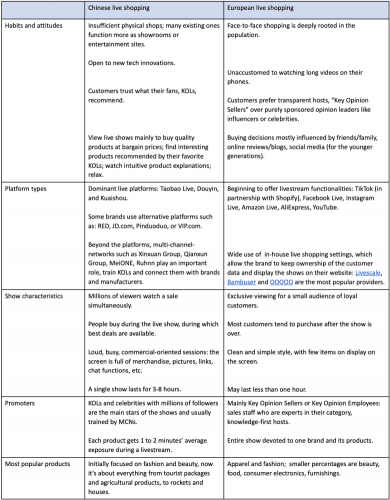
What can Europe learn from China’s live e-commerce boom?

Consumers in the United Kingdom, Spain, France, and Poland expressed interest in live e-commerce for online shopping, with 70% expressing interest. In 2020, Western brands will see 15 times more engagement in live e-commerce than they did on traditional social media, three to five times more sales, and a 50% increase in customer numbers.

If China’s growth trajectory is followed, Europe has the potential to reach over 160 million live streaming e-commerce consumers by 2024, with about 100 million of them making purchases while viewing live feeds.

China is about five years ahead of Europe in terms of economic development. China’s experience may provide us with valuable lessons. It took China a few years to turn live e-commerce into a popular format used by both companies and consumers on a regular basis. Europe is currently in the research and development phase, but we can anticipate some significant changes in style and approach:


Link: https://technode.com/2021/11/04/what-can-europe-learn-from-china-livestreaming-ecommerce-boom/ 


Can C-Beauty Brands Cultivate Loyal Consumers?

Florasis, which ranked third on Tmall’s “Double 11” best-selling brands list in 2020, has dropped out of the top ten this year. Local beauty brands frequently spend more than 65% of their income on marketing, substantially exceeding the market norm of 30-40%. Although their massive advertising, KOLs, and live streaming budgets quickly generated social buzz and attracted new customers, they failed to maintain user loyalty.

“Through data analysis from ByteDance, we found out that most international companies work on the branding side, while Chinese brands focus more on the performance side,” Hwee Chung, Kantar Worldpanel’s head of the China beauty market, stated. That is, Western brands employ influencers to create a desirable atmosphere around their products in order to attract customers. Domestic brands, on the other hand, use low pricing and KOL promotions to entice customers to buy specific products. R&D and licencing are not addressed by C-beauty brands. Yatsen Group, for example, holds 38 licence patents, but Procter & Gamble files 3,800 licences each year.

Link: https://jingdaily.com/c-beauty-brands-loyal-chinese-consumers/


Changing Attitudes Towards 11/11 Shopping Festival?

Despite setting new sales records, Alibaba and other e-commerce companies are keeping their sales figures quiet this year.

Alibaba attempted to rebrand “Double Eleven” as the Chinese government pursued attempts to regulate big digital businesses and wipe out the worst excesses of economic inequality. The company’s annual promotional extravaganza lacked the star power of prior years, with green efforts, homegrown companies, and rural products taking centre stage.

Link: https://www.sixthtone.com/news/1008954/alibaba-tries-an-unfamiliar-new-singles-day-strategy-restraint


Douyin City

This is a big IP from Douyin. This offline event was held for three years by Douyin in collaboration with local tourism/brands. Every time they visit a city, they should promote both the place and the companies. They’ve visited over 70 cities, and this time they’re in Sanya. Its goal is to raise awareness of Douyin through various activities such as dreamland, a music festival, and a webcast. People will also learn about the city, where to go, and what distinctive foods they have, among other things. They built six blocks for Sanya’s Dreamland, where players can take on various identities, complete stages, and win prizes.

They used VR, AR broadcast, and the Douyin micro application to create interactive and social situations. People would be able to see brand information through virtual reality and augmented reality interactive experiences. Celebrities and musical KOLs were also asked to attend the festivals. This is a win-win idea for both Douyin and the cities; by uploading short videos with #Dou In the City, KOLs will encourage more people to come and visit. This effort will give the KOLs more exposure.

Link: https://mp.weixin.qq.com/s/Imd1eRm2LYkcR9auoLWXKA


Singles’ Day posts record haul despite slower pace, as China’s antitrust moves dampen world’s biggest online shopping event

The world’s biggest online shopping event recorded a slower pace of annual growth after Alibaba Group Holding swapped the usual razzamatazz of Singles’ Day for a more down-to-earth event that stressed sustainability.

The gross merchandise value (GMV) for this year’s Singles’ Day reached a new high of 540.3 billion yuan (US$84.5 billion) across the 11-day campaign, representing an increase of 8.45% year on year. Since Alibaba launched Singles’ Day in 2009, this is the first year of single-digit GMV growth.

  1. This year’s Singles’ Day was weighed down by China’s slowest economic expansion pace in decades, as growth slowed to 4.9 per cent in the third quarter
  2. This year, Tmall issued 100 million yuan worth of ‘green vouchers’ to encourage purchasing decisions that ‘contribute to an environmentally friendly lifestyle’

Link:https://www.scmp.com/tech/big-tech/article/3155762/sales-growth-alibabas-singles-day-drops-amid-chinas-crackdown-big


How to Recontextualize Brand Narratives in China

The house’s 70th-anniversary campaign, which featured Max Mara’s iconic Teddy, was a major hit in China, driving organic social traffic to offline footprints.

Image courtesy of Max Mara’s Mini Program.

  1. With a sophisticated understanding of China’s digital ecosystems, Max Mara has successfully built up a content-to-commerce loop.
  2. Luxury brands need to tailor social currency that can be showcased and shared with users’ friends via social platforms, per each campaign’s themes, as well as each platform’s user demographics and capabilities.
  3. Global HQs of luxury brands need to be aware of the uniqueness of China’s ecosystems and allow higher flexibility in experimenting with innovative approaches in the market.

Link:https://jingdaily.com/max-mara-70-anniversary-campaign-china/

WeChat for Beauty/ Makeup Sector

Thanks to rising disposable incomes in urban areas, consumers in China are increasingly interested in health and beauty products such as cosmetics, perfumes, fashion accessories, and vitamin supplements.

The Chinese beauty, cosmetics, and grooming market is second only to the US in terms of size and maturity after several years of rapid expansion. Although some newbies to the industry have begun to climb the rankings, foreign brands continue to outperform domestic players.

Beauty Brands and WeChat

Brands in China are turning to the WeChat app to move beyond generic marketing and into a more personal level of connection, interaction, and targeting. Many people are discovering that using WeChat to take a customer-centric strategy produces greater results than merely posting and sharing blogs and other information.

Offering unique deals and exclusive content to subscribers, samples for testing, live event invites, games and competitions with rewards, and loyalty programmes are all examples of connecting with WeChat.


Why WeChat for Digital Marketing?

With so much growth expected in the cosmetics industry, it’s critical for companies to establish brand recognition in China. WeChat accounts for 47% of all mobile time spent and has 1.1 billion daily users, so it goes without saying that this app is critical for organisations looking to expand their digital presence in China. 

WeChat has accumulated a vast amount of user data as a result of its many capabilities and large community. In marketing, this translates to extremely useful data for Paid Media initiatives. In fact, many Chinese businesses begin their digital presence on WeChat before developing their own website or app.


How can WeChat Benefit your Beauty & Service Business?

  • Subscribers can get discounts, rewards, games, entertainment, interactive experiences, and other perks.
  • To fine-tune and optimise targeting based on interest, divide the audience into categories.
  • Customers can be geo-targeted and informed about upcoming in-store deals and specials.
  • Provide customised beauty solutions for each customer.
  • Interact and communicate with people one-on-one rather than in groups.
  • Provide a personalised answer to questions and inquiries (as opposed to automated).
  • During occasions that involve gift-giving, promote and offer extraordinary one-of-a-kind gifts (such as Chinese New Year).


Conclusion

WeChat Ads are a hot trend in China for breaking through and winning over the audience. WeChat offers a wide range of utilities and targets, making it a wonderful chance for businesses and marketers looking to break into China.

While WeChat has a lot of potential for beauty firms, getting started can be difficult. Get in touch with our team if you need assistance with this. We use our experience and knowledge to help businesses establish a digital marketing plan that better targets and communicates with Chinese consumers. Contact us via phone or email for more information.


This Week’s China Learning

2021 Beauty Industry White Paper

Although this white paper focuses on China’s cosmetics industry, many of the conclusions are applicable to China’s other industries.

Main takeaways:

  • A content-focused strategy is becoming increasingly important, rather than a price-focused strategy.
  • Brand building has been a priority for both foreign and domestic brands. They are increasingly focusing on long-term brand equity/notoriety rather than short-term ROI.
  • In China, young internet customers remain the most significant market for most brands. Women under the age of 40 account for approximately 70% of the global cosmetics market, significantly outnumbering their demographic share.
  • As the appeal for transactional techniques fades and becomes increasingly unsustainable, younger consumers are more affected by brands and content that resonate on an emotional level and match with their value system. As a result, marketing is far smarter and more fascinating now than it was in the days when all you had to do was decrease the price.

Link: https://www.kantarworldpanel.com/cn-en/news/2021-Beauty-Industry-White-Paper?utm_source=news_chinaskinny_com&utm_medium=email&utm_content=The+Weekly+China+Skinny&utm_campaign=20211102_m165346214_20211102+-+1&utm_term=2021+Beauty+Industry+White+Paper


B2B Marketing in the Post-LinkedIn Reality

Maimai 脈脈 is a homegrown social-networking platform for professionals to create business connections, the Chinese equivalent of Linkedin. It now has more than 80 million high-value real name users with more than monthly active users of 30 million.

Through Maimai, marketers can convey their advertising message into different types of Ad formats including Splash Ad, Native Ad, and instant message, etc. Additionally, marketers could target the audiences in different positioning based on their geographic location, gender, career position (C Levels/ Directors / Managers grade), job industry (Business / Legal / Finance/ Design/ IT, etc), and even their specific company.

Link: https://www.xinergy.global/maimai-the-chinese-linkedin/


The older Chinese consumers turning silver into e-commerce gold

A few months ago, the Chinese government was encouraging the biggest Chinese apps to prepare elderly-friendly versions. More than 264 million people, or 18.7% of China’s population, are aged over 60 in a country that is ageing rapidly, according to census results published in May.

COVID-19 forced many Chinese 60+ online making for an expanding population of “silver-haired” internet users who have made the move to online shopping in China in the past year, nudged by the coronavirus pandemic, government policy and e-commerce giants. JD reports that retirees living in major cities, with money to spend and plenty of time, were some of the most prolific shoppers since the pandemic, with over half of the goods catering to the elderly bought by users themselves this year.

In the first three quarters of this year, purchases by the silver-haired demographic grew almost fivefold year on year, with users focusing on leisure purchases, such as gardening supplies and package tours. To really tap this market, online vendors need to simplify their designs or offer user-friendly guides for their apps or websites.

Link: https://www.scmp.com/news/china/article/3153456/older-chinese-consumers-turning-silver-e-commerce-gold


GUCCI– burst game

For its product burst, Gucci, a worldwide luxury brand, devised an innovative H5 game that allows users to engage, comprehend items, and expose brands by avoiding obstacles in the tunnel.

Burst’s shoes “gallop” in a 3D three-dimensional colour tunnel. At the 8m position, there are two operation guide arrows. Users can use the up and down arrows to directly drag bursts around the tunnel to escape impending obstacles by clicking and dragging it. There are timers and score reminders in the game. If you run into any barriers, the game will automatically finish and the game results page will appear.


Luxury brands are ditching KOLs for virtual influencers in China: how Alexander McQueen, Dior and Prada are turning to digital avatars and AI idols to woo millennials

Making their way from music to fashion, virtual idols are paving the way for mixed reality initiatives, increasingly appealing to younger, digitally native consumers.

As more consumers move online, they will increasingly demand compelling narratives like Maie’s from their virtual idols. It seems, every luxury consumer will be able to hatch their own virtual idols in the future.

Link: https://www.scmp.com/magazines/style/luxury/article/3153210/luxury-brands-are-ditching-kols-virtual-influencers-china


Podcasts in China

Despite the fact that podcasting has been around for almost two decades in the United States, with more than 41% of adults aged 18 and above listening to a podcast at least once a month in 2021, it is still a relatively new industry in China. Listeners in China are more familiar with government-controlled broadcasting and state-owned public radio than with on-demand audio content from private creators.

Ear Economy in China

However, in recent years, the internet audio business, also known as the “ear economy,” has grown rapidly. Podcast listening has become a regular fad in many young Chinese consumers’ lives. 

As a result of the expansion of commuter culture and easy access to different media content. Given the pervasiveness of smartphones in Chinese culture, all audio-visual content is now mobile-friendly. This is one of the factors that can be used to explain why podcasts are becoming more popular. 

Chinese podcast listeners are estimated to reach 85.6 million by the end of 2021, second only to the United States. Nonetheless, given China’s massive population, this only accounts for 6.1% of the country’s population, indicating that there is plenty of room for the market to expand.


The Growing Popularity of Podcasts in China

China’s low adoption isn’t due to a lack of interest in digital audio. In this sense, Chinese consumers have a wide range of options, including ebooks, audio live streaming, social audio, and karaoke, all of which fight for ear time. 

Regardless, China’s desire for podcasts—which is defined as any audio-first serialised episodes that can be accessed via digital streams or downloaded, as well as heard as podcasts via video platforms—is apparent. 

Chinese tech companies, including some of the country’s most well-known digital giants, are jumping into the booming audio category, establishing dedicated “podcast” sections. Tencent Music and Entertainment, for example, has recently been promoting “long-form content.” 


Chinese Podcast Listeners’ Demographics

The root of China’s developing podcast market is a growing demand for tailored, personalized, and individualised media tastes as a result of economic liberalisation and urbanisation. The thriving sector includes a wide range of themes, from travel to hobbies — and everything in between.

In terms of audience, over 68.2% of respondents live in top-tier or coastal cities such as Beijing, Shanghai, and Guangzhou, according to the PodFest China 2020 Chinese Podcasting Listeners and Consumption Survey. The majority of podcast listeners are under the age of 35, with more than 88.5% being under the age of 35.

Podcasting is also popular among the well-educated, with 86.4% of listeners having a bachelor’s degree or more, but only 28.6% of short-video users had attended college.


Conclusion

China’s podcast sector appears to have a bright future. In 2019, China’s podcast sector generated US$193 million in revenue, making it the world’s fastest-growing podcast market. The market is expected to grow at a 37.3% CAGR before 2024, reaching a total value of US$689 million in 2024, owing to increased listener numbers, making China the world’s second-largest market if the revenue target is met.

However, the market expansion will need to be closely monitored in the future. With only 6% of the population reporting that they listen to podcasts, there is a lot of room for expansion. As a result, starting a podcast for your company could be a wise decision for the future of your business.

Do you think starting a podcast is simple? Well, think again. You do need considerable support and guidance. Hit us up to get the ins and outs sorted professionally and launch a cohesive campaign.

WeChat for Education Sector

With the growing competition in the foreign education market, education brands are looking for new ways to attract Chinese students, such as incorporating e-learning courses, offering home and distance learning, and establishing physical campuses in China, among other things. As the educational landscape becomes more digitally disrupted, most educational marketers have begun to embrace digital platforms and compete in the brand and marketing area.

With over 1 billion registered users till Q1 2021, 780 million using WeChat Moments and 400 million using Mini Program, WeChat can be greatly beneficial to education sectors.

How does WeChat benefit the education sector?

One of the most difficult challenges for educational institutions such as colleges is building an efficient content marketing strategy that communicates to all of their various audiences.

WeChat advertising comes in handy in this situation. Because of WeChat’s developed digital ecosystem and vast user database, it is a common tool for education brands to leverage in their digital marketing plan. Marketers may use WeChat’s smart data capabilities to execute targeted ads and obtain vital consumer insights. 

Creating well-developed, highly detailed personas — fictional characters that encompass a certain target group or demographic, based on market research and genuine data – is one of the first steps in constructing an efficient content marketing strategy for educational organisations on WeChat.


Here are some ways education sectors can leverage the WeChat platforms:

  • Product Promotion
    WeChat advertising is helpful in guiding visitors to online sale sites when a business is launching a new collection or wants to promote hero products and stimulate direct sales through its marketing.


    To advertise its Chinese EMBA courses, the Chinese University of Hong Kong conducted a WeChat marketing campaign. The ad’s creativity enticed users to schedule a one-on-one inquiry session in Guangzhou or Shenzhen. Users were routed to the university’s official website when they clicked on the ‘details’ button.

    WeChat advertising is applicable to a wide range of scenarios, and brands can discover the appropriate solutions based on the characteristics of various sectors. 
  • Lead Generation Campaign
    In its ad structure, WeChat advertisements can enable simple sign-ups for lead generation campaigns. During the campaign, user conversion can be successfully boosted, which can also lead to increased brand recognition.
     

    A WeChat moments ad intended at increasing the number of direct sign-ups for an education service company that provides counselling and help for students choosing international universities. The ad presented the major selling features of its service and offers with a basic creative and provided a list of its partnered schools and colleges throughout the world.


  • Others
    WeChat also provides other services like selling webinars or one-on-one coaching sessions, selling books and products, translations, etc. Students can see everything from scientists teaching quantum physics to professors providing writing tutorials for college applicants. Amateur enthusiasts can also learn from mountaineers, hikers, and photographers.

Conclusion

The development of mobile technology has ushered in a new era of informal, personalised, lifelong learning outside of the classroom. However, when it comes to efficiently implementing mobile learning, we’re still figuring it out.

WeChat is installed on practically every other person’s smartphone in China, as it is widely used in almost every field of life. This is the only app that overseas students in China use. As a result, any company looking to establish a presence in China’s education market should consider starting with a WeChat account and leveraging the available tools.